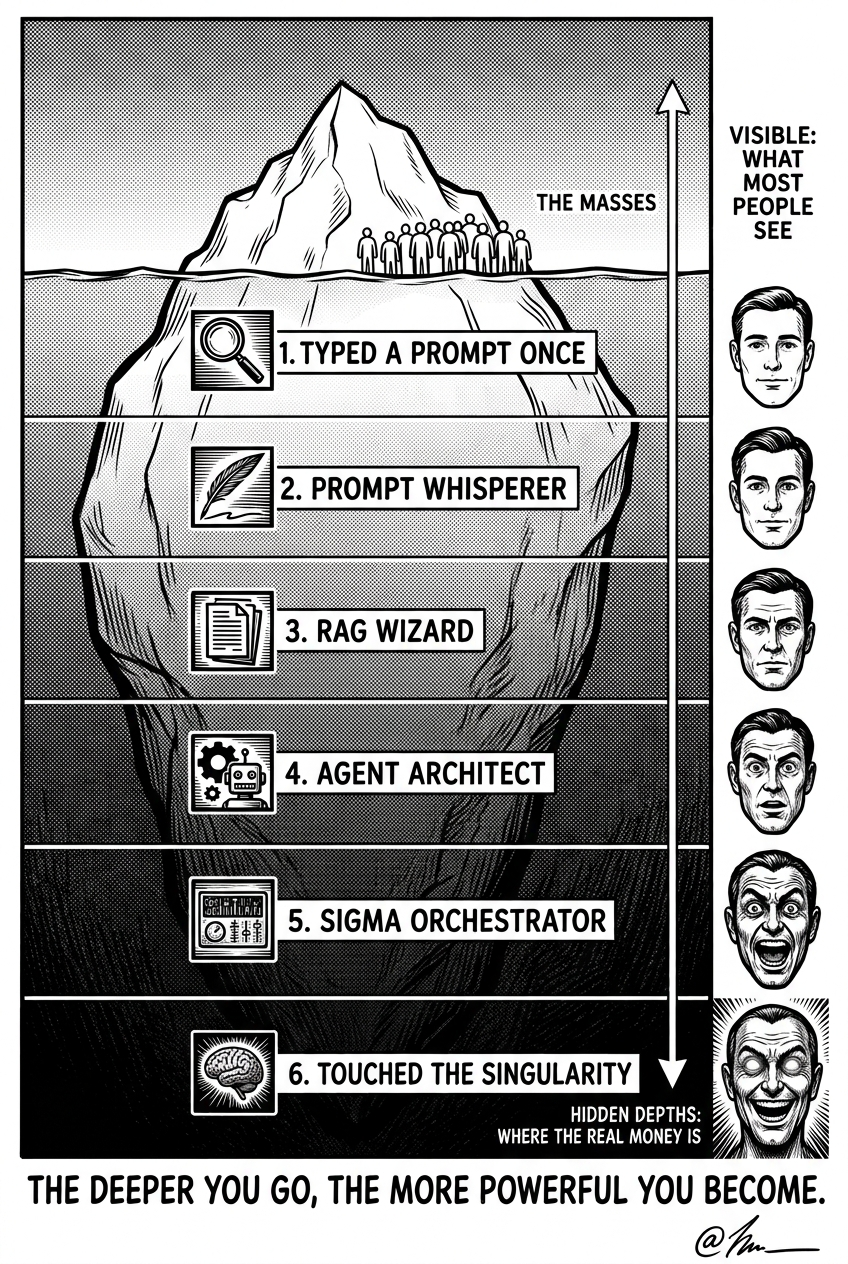
I keep seeing the AI iceberg diagram. ChatGPT and prompting sit at the tip, above the water. Below that it drops through agents, MCP, RAG, fine-tuning, orchestration, each layer darker than the last. As a map of the parts, it’s accurate enough.
It starts with FOMO
“Most people never get past the tip.” “Which level are you on?” That turns a map of tools into a verdict on you. Knowing only the surface tools gets read as being behind, and there’s a course or a consultant at the bottom ready to sell you the rest.
It’s a bad metaphor
The iceberg is drawn as a gate, sometimes with a gatekeeper standing at it. But the gate isn’t real. What you reach for depends on the problem in front of you, not on where someone decided to rank it on a diagram. The only hurdle is the basics, and the basics are free. Learn them and you’re an educated consumer: you can build the simple version yourself, or hire the rest out because you decided to, not because a diagram told you that you were behind.
You decide what it can do
Strip the fear off and an agent is a short list:
- a model
- a job you can state precisely
- the tools you expose to it, the specific things it’s allowed to see and do
- a loop that lets it take a step, see the result, and decide the next one
- some memory to carry what it learns
- a way to check whether it did the job
The rest is deciding what to hand it, and there’s no diving to a deeper layer to unlock any of it. You draw the boundary.
Say you want one to help triage customer feedback. You choose what it can reach: the state of a customer’s account, the actions that would resolve a common issue, a place to write down what it learned so an internal FAQ builds up over time. Each of those is a tool you expose on purpose, and what you don’t expose, it can’t touch. Those tools are also where most of the work sits, because they’re wiring into systems you already run.
You also decide the limits, how much it does on its own, which actions it takes versus only suggests, and how far the tool surface reaches. A read-only agent that drafts a reply for you to approve is a different thing from one that closes the ticket itself, and you decide which you’re building. I lean on a couple of agents for the repetitive work in Boswell, and every one started narrow and widened only as I came to trust it.
There are no secrets
The deep layers get drawn as dangerous territory, but most of them are just integrations, and plenty are optional or beside the point for what you’re building. It’s a pile of vendor names on a diagram, and every one is documented in the open and free to start.
- Anthropic Academy, free courses, plus the docs and quickstart repos you can clone today.
- Agent frameworks, all MIT-licensed and readable: LangGraph, CrewAI, LlamaIndex, and the OpenAI Agents SDK.
- MCP, the open standard for wiring an agent to your tools and data. Public spec, free SDKs.
- More courses, Hugging Face’s free Agents Course and DeepLearning.AI short courses.
Watch how the help gets sold
The first flag is how far behind they say you are. If a post or a course leads with how many levels you’re missing, that’s the FOMO again, dressed up as teaching.
Another flag is danger. If the pitch is that you’re about to step over a line you shouldn’t, that this is too deep to touch without them, that’s gatekeeping. Good help runs the other way. You know your problem better than they do. A good partner brings the how, the work of turning your idea into something that runs. That matters most when you’re not building it yourself. They get in it with you instead of warning you off.
Anchor on your own problem. What do you want the thing to do, and did it do it? “Which level are you on” doesn’t answer that.
So skip the ranking. Build the smallest agent that could solve your problem, and check that it did.
If you get past that and hit a wall, send it over. I’m happy to look.