2026-05-07
Your Hiring Process Is a Mirror
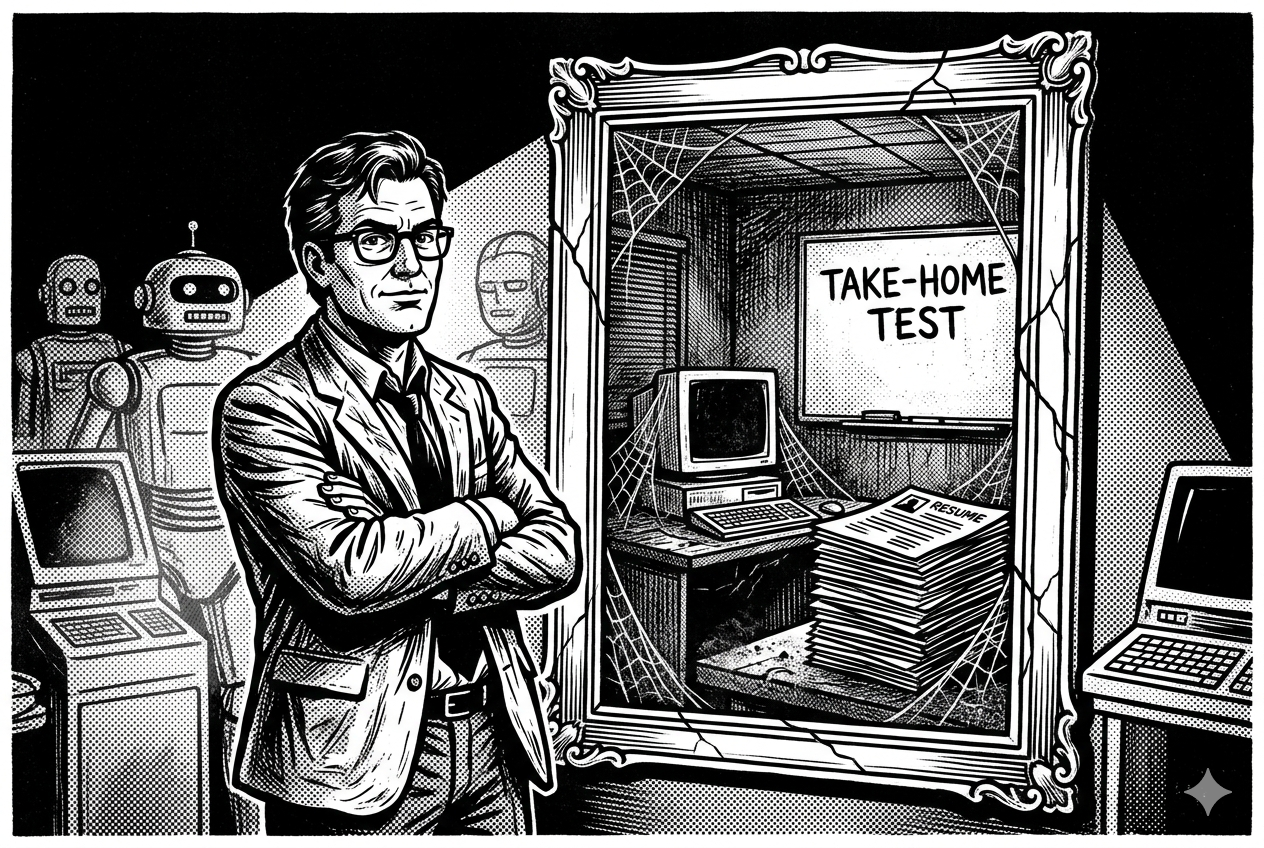
I was approached for a senior Rails role through a staffing agency. The evaluation was three stages: a take-home coding test, a live coding test, and a shop talk. I’ve been building software for 30 years. I declined and told the recruiter exactly why.
Two Negative Signals
I understand agencies need margin, and I was willing to flex on comp to account for that. The rate was below market for the experience level and there was no room to move. There should be space in there.
Then the process from the client company. Take-home, live coding, shop talk. Unchanged from years ago. The org is defining and evaluating the role like the job hasn’t changed in five years, but it has, and they are indicating they are behind.
You are not going to find the right person by lowballing and running a stale process, unless the right person is always defined as the cheapest one willing to jump through old hoops.
What Software Engineering Looks Like Now
Software engineering is no longer “can you write code unaided in a controlled environment.” You don’t have to do it that way anymore. You can fight that all you want, sneer at the next generation as not being talented enough to do it the “right” way, but that way is well and truly done.
I use my time making sure business goals get properly encoded into products and processes. I do that through AI-augmented workflows, multi-agent orchestration, and building the rules and skills that let autonomous pipelines ship code from spec to merged PR. I have written about this progression before, from understanding the 100x claim to attempting a fully autonomous Dark Factory.
The job has changed. Many organizations have not yet caught up. I have spent little time in mainstream corporate America, so maybe I sound off base, but upstarts are operating in fundamentally different ways while incumbents run business as usual. That is hard to ignore.
Engineers who have moved on to AI-native workflows see an old vetting process and pass on it. They are not in the pipeline. If you want to preserve the status quo, that is fine. If you don’t, it is time to change your process.
The Mirror
A hiring process is a window into how the team builds software. If the evaluation has not changed, the work probably has not either.
This is not personal. I told the recruiter the same thing I am writing here. It is information, and it is useful from both sides of the table.
The Opportunity Cost
If you are in survival mode, take the work. This is not about that.
But accepting a misaligned role is time spent using last decade’s methodologies, which means you become less relevant over time. Tenures are shorter and layoffs are more frequent. When the contract ends, you re-enter the market further behind than when you started.
The Middleman Question
The matchmaking side of staffing agencies, the part that justifies the margin, is fragile. AI is shrinking headcount needs, and the talent access agencies used to have over their clients is not what it was. I wonder how long this model holds.
What I Did Instead
I told the recruiter directly: the process is a signal, I understand the agency dynamics, but this is not aligned. Keep me in mind for roles that are.
Then I went back to the work. Building Boswell for nonprofits, co-founding Harmonic.fm with domain experts to help independent musicians, advancing the consulting practice, with more on the way. I am open to joining someone else’s org when it makes sense. Time is finite, and I would rather spend it on aligned work than jumping through a process that already told me what I needed to know.
Hiring processes are a mirror. If you are evaluating senior engineers in 2026, check what yours reflects before candidates do.